
Continuous sodium monitoring to guide proactive treatment.
Natrium is developing a wearable biosensor that tracks sodium continuously, so clinicians can see trends and direction instead of isolated lab values.
Sodium imbalance is common, serious, and costly.
Hyponatremia affects roughly a third of hospital admissions. It is associated with higher mortality, longer hospital stays, and higher costs. It is often managed with lab draws taken hours apart, which inhibits timely treatment decisions.
Sources: hyponatremia prevalence reviews; Waikar SS et al., Am J Med 2009 and Wald R et al., Arch Intern Med 2010 (mortality); Amin A et al., J Med Econ 2013 (length of stay and cost, heart-failure cohort).
Where standard monitoring falls short
Episodic draws miss rapid change
A lab value is a single point in time. Sodium can move meaningfully in the hours between draws, and that movement is not captured.
Lab turnaround delays action
Time from draw to result can postpone decisions about fluids and medication, particularly in unstable patients.
Direction and rate stay hidden
Two patients can share the same sodium value while moving in opposite directions. Trend and rate of change are what guide correction.
Continuous glucose monitoring changed diabetes care by making trends visible. Natrium is applying the same approach to sodium.
Natrium began with a patient.
When I was diagnosed, keeping my sodium stable meant lab draws once or twice a day. I planned travel around finding a lab, missed events waiting on results, and still landed back in a hospital bed when a shift was caught too late.
The only at-home monitor I could find cost around $20,000, out of reach until family and friends helped me raise it. That stopped me cold. If it was this hard for me, how many people were managing the same thing with far less?
Turns out, there were a lot. People in chemotherapy, in heart failure, in intensive care, including someone in my own family whose sodium dropped at home after treatment and sent her to the hospital by ambulance. Andrew and I started Natrium so that people living with this do not find out too late.
- 2023Onset of unexplained symptoms that began affecting daily life.
- March 2024An ICU stay following seizures.
- September 2024An extended workup led to a diagnosis of diabetes insipidus.
- ManagementSodium monitoring became central to treatment, but was difficult to manage with frequent lab draws, leading to multiple hospitalizations.
- FoundingNatrium was started to make that monitoring continuous.
"After my diagnosis, keeping my sodium stable meant lab draws once or twice a day, and I still ended up back in a hospital bed when a shift was caught too late. The only at-home monitor I could find cost $20,000. I knew there had to be a better way, and that I was not the only one who needed it."

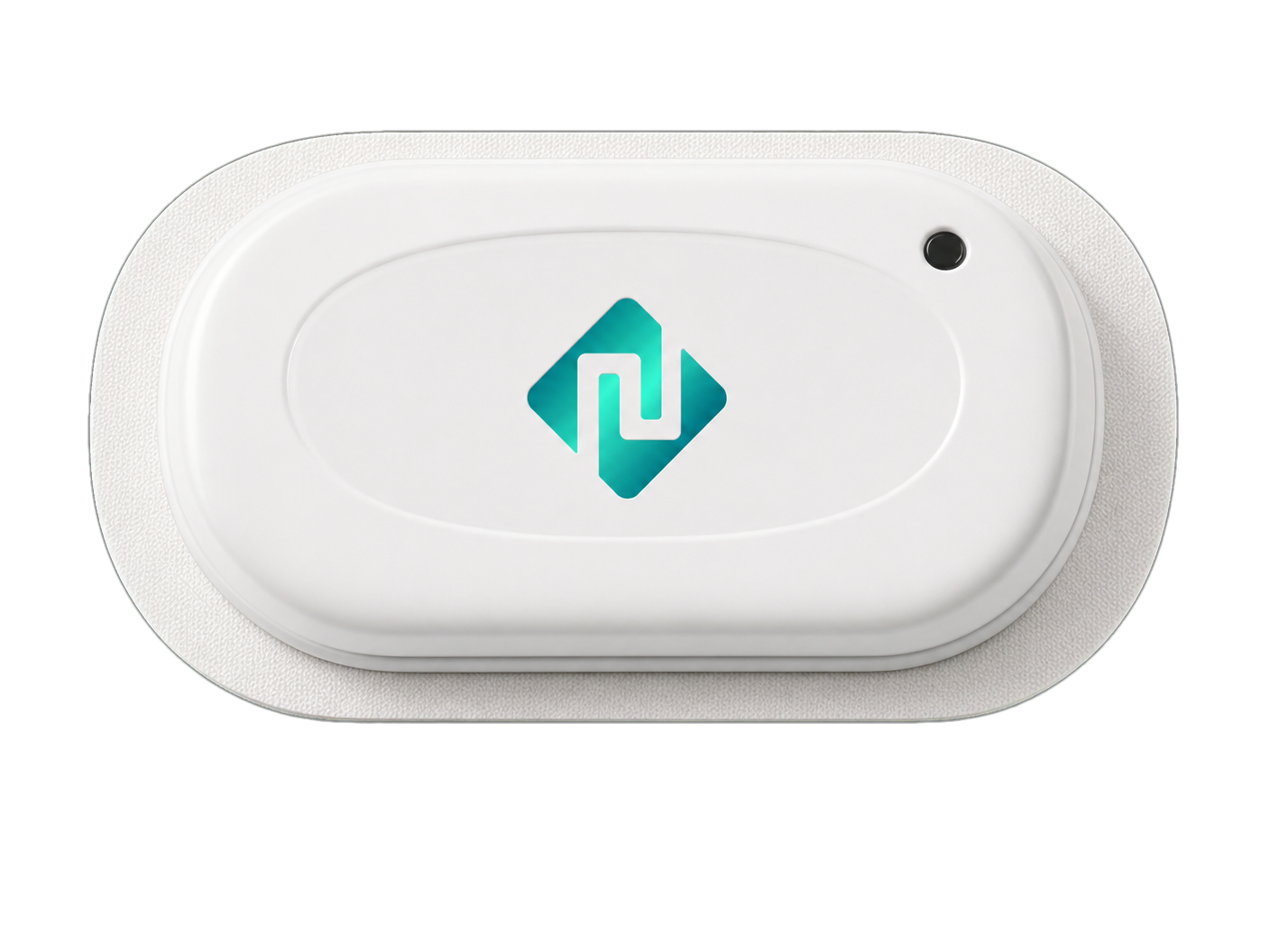
Natrium ONE
A single-use wearable patch for the upper arm, designed to monitor sodium in interstitial fluid continuously and send readings to a clinical dashboard.
Wearable patch
A low-profile upper-arm form factor intended for multi-day clinical and ambulatory wear.
ISF sampling
Minimally invasive access to interstitial fluid.
Sodium sensing
Ion-selective electrodes measure sodium concentration, with a target of under 5% deviation from lab reference.
Wireless transmission
Low-power Bluetooth electronics digitize and transmit readings to a mobile app or EHR.
Clinical software
A dashboard shows the current value, trend, rate of change, and threshold-based alerts.
Platform expansion
The architecture is designed to extend to other electrolytes, including potassium and chloride.
An integrated four-layer system.
Natrium combines fluid sampling, sodium sensing, electronics, and software into one continuous-monitoring workflow. The summary below is high-level; the specifics are covered by our pending IP.
Sampling
Minimally invasive access to fluid just beneath the skin.
Sensing
Ion-selective measurement of sodium concentration.
Electronics
Compact, low-power electronics with wireless transmission.
Software
A dashboard for current values, trend, and alerts.
Where the work stands today.
Early benchtop testing supports the core sensing approach. This is preliminary feasibility work, not clinical validation. We are currently running multiple 5-7 day long sensing tests for additional data on the sensing technology.
- Demonstrated. A linear (Nernstian) response to sodium across the physiologic range in benchtop testing.
- In progress. Longer-duration stability testing and integrated fluid-sampling feasibility.
- Next. Comparison against standard-of-care lab measurement, on the path toward clinical validation.
Founder-led, with a clear technical path.
Natrium combines founder-led patient urgency with technical invention in continuous biomarker monitoring.
John Stallings
- Former McKinsey; healthcare growth and go-to-market
- Personal experience with diabetes insipidus and sodium monitoring
- Leads strategy, fundraising, and partnerships
Andrew Mancini, PhD
- Lead inventor of the Natrium ONE architecture
- Biosensing, electrochemistry, and engineering
- Leads the technical roadmap and validation
Get in touch.
If you invest, build, or research in this area, we would like to hear from you.
Investors
We are raising to fund our next phase of development and can share our overview.
Request our overviewStrategic partners
We work with manufacturing, design, regulatory, and commercial partners.
Explore a partnershipAcademic & clinical
We welcome clinicians and researchers working in electrolyte monitoring and biosensing.
Start a collaborationGeneral inquiries: info@natriumbio.com